
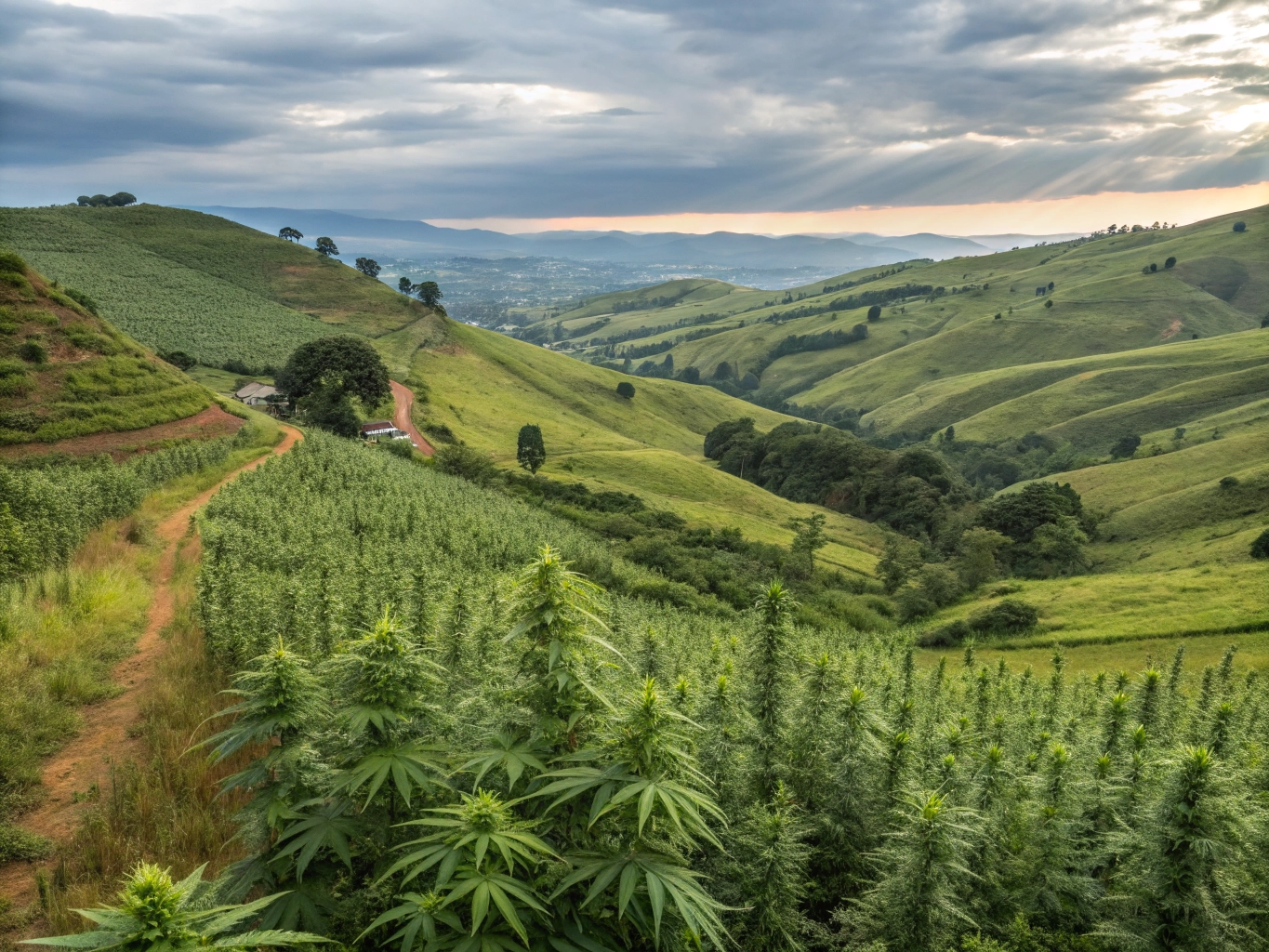
From Ancient African Hills to One of the World’s Most Influential Cannabis Strains
Chapter 1: The Arrival on African Shores (13th-14th Century)
The story of Durban Poison begins centuries before the city of Durban was ever founded.
Cannabis itself originated thousands of years earlier in Central Asia, where wild populations evolved across the Himalayan foothills and surrounding regions.
Long before European exploration, merchants traveling the Indian Ocean trade routes carried cannabis seeds aboard Arab dhows and Indian trading vessels.
Between the 13th and 14th centuries, these ancient trade networks reached the eastern coast of southern Africa. Alongside spices, textiles, ivory, and precious metals came one of history’s most adaptable plants.
The first custodians of cannabis in southern Africa were Indigenous communities including the Zulu, Xhosa, Khoikhoi, and San peoples.
Rather than simply cultivating it as a crop, they incorporated it into everyday life.
Cannabis known locally as dagga, insangu, or intsangu depending on the language became part of:
- Traditional medicine (muthi)
- Spiritual ceremonies
- Social gatherings
- Hunting rituals
- Relaxation after labor
For hundreds of years, farmers unknowingly selected the strongest plants each harvest.
Without laboratories or breeding manuals, they were practicing natural genetic selection!
The subtropical climate of modern day KwaZulu Natal proved nearly perfect.
Warm summers.
High humidity.
Abundant sunshine.
Mountain breezes.
Rich valleys.
Cannabis flourished.
Chapter 2: The Cradle of the Pinetown Hills
As generations passed, the cannabis growing around Durban slowly became something unique.
The rolling hills surrounding Pinetown, the Valley of a Thousand Hills, and extending south toward Pondoland created an ideal natural breeding ground.
Farmers continually saved seed from plants that survived the harsh local conditions.
Over centuries, nature and human selection worked together.
The plants adapted to:
- intense UV exposure
- humid coastal summers
- seasonal drought
- nutrient poor soils
- strong ocean winds
- mold pressure
Instead of developing thick, moisture trapping flowers, they evolved long spear shaped colas with excellent airflow.
Resin production increased to protect flowers from insects and the African sun.
These adaptations created one of the world’s few true cannabis landraces a genetically stable population that evolved naturally within a specific geographic region.
Characteristics became remarkably consistent:
- Tall, vigorous growth
- Narrow leaflets
- Exceptional resistance to mold
- Heavy resin production
- Sweet terpinolene-rich aroma
- Fast flowering for a tropical sativa
- Naturally elevated THCV levels
The result was no longer simply “African cannabis.”
It had become the Durban landrace.
Ancestral Central Asian Cannabis
              │
Indian Ocean Trade Routes
              │
              ▼
 KwaZulu-Natal Coastal Hills
              │
Centuries of Natural Selection
              │
              ▼
 Pure Durban Landrace
 (THCV • Terpinolene • Fast Flowering)
Chapter 3: The Birth of “Durban Poison” (1960s–1970s)
During the twentieth century, South Africa’s cannabis culture continued to thrive despite increasing government prohibition.
Under apartheid, cannabis cultivation became illegal, forcing many growers into remote mountain valleys where the crop often became an essential source of income for rural communities.
Harvests from the inland hills were transported into Durban, the country’s busiest port city.
There, buyers quickly noticed something different.
Compared to compressed imported brick cannabis common at the time, this local flower was extraordinarily potent.
Its effects were immediate:
- intense mental clarity
- soaring energy
- racing creativity
- remarkable focus
Unlike the heavy body effects of many hash varieties circulating globally, Durban’s local cannabis felt bright, electric, and almost overwhelming to inexperienced smokers.
Some users reportedly joked that it was “like poison” because of its incredible strength.
Whether the nickname originated from local growers, international visitors, or early smugglers remains uncertain, but by the 1970s the name Durban Poison had firmly entered cannabis culture.
Ironically, the “poison” had nothing to do with toxicity.
It became a badge of quality.
Chapter 4: The Aerial Spraying Wars
Throughout the 1970s and 1980s, authorities launched widespread aerial eradication campaigns over cannabis growing regions of KwaZulu Natal and the Eastern Cape.
Helicopters flew low across remote valleys, spraying herbicides over thousands of plants.
Entire hillsides appeared destroyed overnight.
Yet Durban’s landrace proved astonishingly resilient.
Several ecological factors worked in its favor.
The Underground Seed Bank
Every harvest released thousands of viable seeds into the surrounding soil.
Many remained dormant for years.
Natural Selection Intensified
Only the toughest plants survived repeated eradication.
Each generation became increasingly adapted to environmental stress.
Nature Reclaimed the Land
Heavy seasonal rains gradually reduced herbicide residues while dormant seeds germinated simultaneously, allowing cannabis to rapidly recolonize abandoned hillsides.
Whether by intention or accident, eradication efforts may have intensified natural selection, reinforcing the resilience that Durban genetics remain famous for today.
Chapter 5: The Amsterdam Connection
By the late 1970s, Durban cannabis had begun attracting international attention.
American cannabis author Ed Rosenthal encountered South African genetics while visiting Amsterdam, where old South Africans were reportedly selling authentic Durban seed stock through the Transvaal coffee shop.
Rosenthal brought seeds back to California, sharing them with cannabis researcher Mel Frank.
Growing the plants in the Northern Hemisphere revealed a challenge.
Near the equator, flowering begins under very different seasonal conditions.
In California, many plants became enormous and flowered too late for commercial cultivation.
Selective breeding focused on identifying naturally earlier flowering individuals while preserving the strain’s unique effects.
Later, breeder David Watson, better known as “Sam the Skunkman,” acquired Durban genetics and eventually transported them to the Netherlands during the early 1980s.
Dutch breeders continued refining the line.
Over successive generations they selected for:
- earlier flowering
- stable sex expression
- consistent terpene profiles
- improved uniformity
The result became the Durban Poison now recognized worldwide a rare example of a nearly pure sativa capable of finishing in only eight to nine weeks indoors.
By the mid 1980s, Durban Poison appeared in Dutch seed catalogues and rapidly became one of Europe’s most celebrated cannabis varieties.
Chapter 6: A Genetic Cornerstone of Modern Cannabis
Durban Poison eventually became much more than a famous strain.
It became one of modern cannabis breeding’s foundational building blocks.
Breeders prized it because it consistently contributed:
- vigorous growth
- exceptional resin production
- mold resistance
- sweet terpinolene aroma
- clear cerebral effects
- high THCV potential
These traits made Durban Poison an ideal parent for hybrid development.
One of its most influential descendants emerged when Durban Poison genetics were combined with an OG Kush derived line to create Girl Scout Cookies (GSC).
That single hybrid helped reshape modern cannabis.
Its descendants include numerous award winning cultivars, including:
- Cherry Pie
- Gelato
- Sunset Sherbet
- Wedding Cake
- Ice Cream Cake
- Cereal Milk
- Runtz (through later breeding influences)
             Durban Poison
                    │
         × OG Kush-derived Hybrid
                    │
          Girl Scout Cookies (GSC)
                    │
      ┌─────────────┼─────────────┐
      │             │             │
 Cherry Pie     Gelato      Sunset Sherbet
      │                           │
Wedding Cake             Ice Cream Cake
                    │
                 Modern Hybrids
Today, countless dispensary shelves around the world carry genetics that trace part of their lineage back to those resilient African hills.
Chapter 7: Durban Poison Today
Finding a true, unhybridized Durban Poison has become increasingly difficult.
Decades of crossbreeding have diluted many original lines, and numerous commercial versions differ substantially from the historic South African landrace.
Preservation breeders continue searching for authentic genetics in South Africa while maintaining older seed collections in Europe and North America.
Although variations exist, genuine Durban Poison remains instantly recognizable by its distinctive profile.
Cannabinoids
- THC: 15-25%
- THCV: Higher than average
- CBD: Very low
Dominant Terpenes
- Terpinolene
- Ocimene
- Myrcene
- Pinene
Aroma
- Sweet anise
- Licorice
- Fresh pine
- Citrus peel
- Herbs
- Earth
Effects
- Clear headed
- Energetic
- Creative
- Euphoric
- Focused
- Social
Unlike many modern hybrids, Durban Poison rarely produces heavy sedation, making it one of the few classic daytime cultivars that has remained popular for decades.
Quick Reference Profile
| Trait | Description |
|---|---|
| Type | Pure South African Landrace Sativa |
| Origin | KwaZulu Natal, South Africa |
| Historic Region | Durban, Pinetown, Valley of a Thousand Hills |
| Flowering Time | 8–9 weeks (selected Dutch line) |
| Dominant Terpene | Terpinolene |
| Key Minor Cannabinoid | THCV |
| Typical Aroma | Sweet anise, licorice, pine, citrus |
| Growth Habit | Tall, vigorous, mold resistant |
| Best Known For | Clear, energetic cerebral effects |
Epilogue: The Legacy of an African Icon
Few cannabis varieties can claim a history as rich as Durban Poison.
Born from ancient trade routes, shaped by centuries of natural selection, and preserved by generations of South African growers, it survived prohibition, eradication campaigns, and the relentless march of hybridization. From the misty hills of KwaZulu Natal to Amsterdam’s pioneering coffee shops and eventually into breeding rooms around the world, Durban Poison became far more than a regional landrace it became a cornerstone of modern cannabis genetics.
Today, its influence lives on in countless celebrated cultivars, yet the original Durban landrace remains a symbol of resilience, adaptation, and heritage.
Every authentic Durban Poison plant carries echoes of the African soil that shaped it, the farmers who safeguarded it, and the remarkable journey that transformed a local “dagga” into one of the most respected cannabis strains in history.
One historical note: The only section I’d soften is the statement that helicopters sprayed glyphosate specifically. South African eradication campaigns used aerial herbicide spraying, but the exact chemicals varied over time and by operation, and documentation isn’t always consistent. Referring more generally to “herbicides” makes the account more historically defensible. Similarly, the “poisonously strong” explanation for the name is popular and plausible, but it should be presented as tradition rather than established fact. These small changes strengthen the credibility of the entire piece.