
This post was created by a human with the assistance of AI tools. It combines comments shared during the webinar with the official transcript. Please note that some addresses may need adjustment, as we’ve kept the text raw to preserve authenticity. If a link doesn’t work, it may have been copied directly or merged from two lines. Transcript is also included as a comment at the bottom for reference.
South Africa cannabis industry woke up and realizes time is flying fast.
The “Pathways to Legality” webinar on November 11, 2025, marked the launch of a national conversation series on Project Indlela, a community driven push to build an inclusive cannabis framework.
It was hosted by Cannabiz Africa and the South African Cannabis Club Alliance (SACCA), the event featured Deputy Minister Pinky Kekana from the Presidency and drew over 130 stakeholders, including legacy growers, club operators, educators, and tech innovators.
Discussions revealed government openness to reform while highlighting industry frustrations over delays, exclusion, and the unregulated grey market.
Attendees expressed a mix of optimism for collaboration and urgency for concrete action, emphasizing that words must turn into timelines and equitable policies.

South Africa cannabis industry Signals Progress Amid Historical Barriers
Deputy Minister Kekana traced cannabis debates back to the 1961 UN Single Convention on Narcotic Drugs, calling it outdated and a hindrance to economic growth.
She reaffirmed the 2009 outcomes based approach to transform lives through inclusion, investment, and job creation.
The Cannabis for Private Purposes Act (2024), stemming from the 2018 Prince judgment, enables removal of cannabis from the Drugs and Drug Trafficking Act of 1992, paving the way for industrialization.
Draft regulations are in final review at the Department of Justice. Cabinet’s 2019 decision led to the National Cannabis Master Plan, now under review for better hemp integration and infant industry support.
Minister Pakau heads implementation, focusing on mentorship and pilots to onboard legacy farmers. Three urgent streams were outlined: regulatory reform, quick wins under existing laws, and a full plan.
Kekana stressed value addition in manufacturing for local/export markets, rural development, and prioritizing Indigenous communities and SMMEs in supply chains.
Attendees welcomed this alignment but pushed for faster execution, noting the plan’s unsigned status due to gaps in social partner buy in.

Industry Demands De scheduling and Moratoriums
Stakeholders highlighted the grey market’s scale estimated at thousands of outlets and pop ups creating jobs but excluding Indigenous groups historically criminalized under apartheid era laws.
Calls were strong to de schedule cannabis entirely, treating it as an agricultural commodity rather than a Schedule 6 substance under the Medicines Act.
This would unlock a new Cannabis Regulations and Economic Inclusions Bill, allowing coexistence of non commercial clubs, dispensaries, and marginalized growers. A moratorium on unnecessary arrests topped demands, especially for traditional users.
The industry is organized with club systems, taka Spaza shops, and farmers ready for CSIR tested safe practices ahead of 2026/2027 commercialization.
Proposals included a national summit on April 20, 2026, for cross department collaboration (SAPS, DTIC) and raising THC limits beyond 2% to avoid criminalizing law abiders.
Frustration surfaced over persistent arrests despite 2023 SAPS directives and SAHRC statements upholding privacy rights and collective ownership in ethical clubs.
Project Indlela’s Hub Model: Inclusion vs. Exclusion Debate
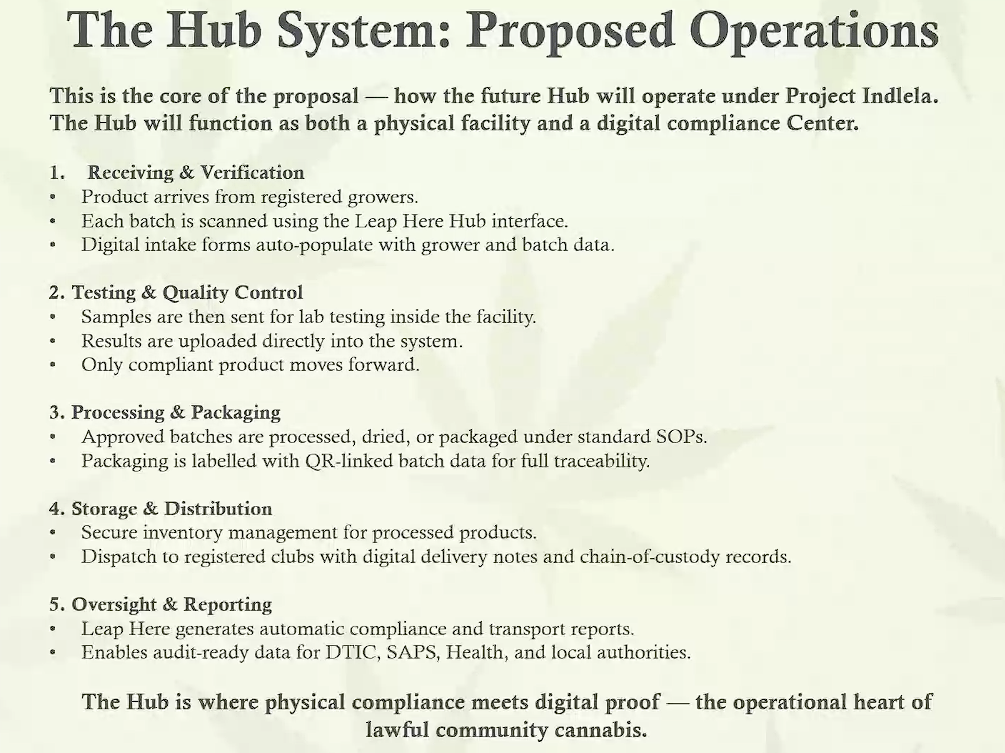
SACCA, founded in August 2025, presented Project Indlela (“the way forward”) as regional processing hubs municipally backed but low funding connecting rural growers to compliant distribution.
Growers supply hubs for verification, testing, packaging, and offtake contracts; products flow to clubs or dispensaries with quotas for landrace strains.
Editor note (This is where I picture the people on the ground the Snyman people, all walks of life people can bring their product and get it tested and sell it off so it can be graded and passed on to the consumer). It sounds like they want to be able to sell it straight without the hub as the middleman, and honestly I can see a future like that if they make it like the small scale alcohol permits, someone comes and checks if you would be doing it in a proper and nice manner, then like a micro alcohol brewery they pay a small fee to join and they sell it above board with good health and safest standards just like alcohol? I can see a way that’s the way forward but only if we let the people know, and trust me they know they are in the meetings)
Clubs act as non profit harm reduction and education centres, enabling private access via pooled resources (no profits, reinvest in community).
Tech demos included Joint Venture Collective’s Lipia software (grower/processor/club modules live; hub prototype in development) for seed to sale traceability, QR codes, and auto-reports.
Grow one Africa‘s GAO Light platform serves 16 clubs with 6,000+ members, using AI for consumption forecasting in a closed loop economy; AfriMeter expands to shared data dashboards.
The debate intensified on equity: some saw hubs as legal entry for Indigenous growers, rectifying value chain disruptions.
Others criticized it as exclusionary, keeping original San people and Snyman beyond cultivation, echoing apartheid separations. Concerns arose over NPC models’ sustainability (no bank loans) versus Pty for economic growth, and accessibility of software/training costs.
Unity calls urged federations like SACHIDA to bridge silos, with all uses traditional, medical, recreational, industrial needing protection without commercial domination.
Legal Complexities and Path Forward
John Jeffery (ex DTIC, now consulting) clarified delays: regulations define amounts for enforceability (NPA/police request), expected early 2026 with parliamentary approval.
Cannabis is limited to flowering tops; seeds/stems excluded. Hemp caps at 2% THC under the new Plant Improvement Act (December 1, 2025); higher THC becomes a declarable crop via Agriculture permits.
A three prong strategy: activate Private Purposes and Plant Improvement Acts; short term amendments (e.g., Small Business Act for licensing); omnibus bill for a regulatory authority.
Section 21/22 dispensaries drew scrutiny 95% serve recreational users via fraud, dumping rejects on streets; no domestic medical production exists, exports only.
Jeffery agreed outlets are largely illegal but cautioned against mass enforcement, pushing consultation.
Stakeholder groupings (hemp, cannabis, traditional) will hold virtual briefings for input.
Attendees felt the gray zone’s reality is finally acknowledged, but political will lags nine departments cause communication breakdowns.
UN treaties are monitorable but not enforceable; Constitution prevails, with no penalties for decriminalizing nations.
Education and Economic Urgency
Cheeba Academy launched Africa’s first higher certificate in cannabis (CHE accredited), with Jobs Boost training 90 youth.
Mulu Hemp counters with Agri SETA Level 4 since 2020 (isiZulu curriculum).( if someone has a link for this company please comment below so I can add it here)
Basic grower courses were proposed pre licensing.
High training costs alarmed participants, especially with no active market; foreign investors flood in while locals face loan burdens post certification. Recreational cannabis could generate tens of thousands of jobs in farming, retail, and logistics critical for unemployment.
Enforcement Realities: Moratoriums, Precedents, and the Upington Shadow
John Jeffery, formerly with the Department of Trade, Industry and Competition (DTIC) and now consulting on cannabis matters, drew a sharp parallel to decriminalized sex work: arrests for buying or selling have ground to a halt, while human trafficking remains prosecuted.
He argued that pursuing Rastafari or small scale users for minor infringements like personal consumption or R300 sales serves no purpose and inflicts needless harm. Large scale sales and transport stay illegal, but Jeffery revealed he’s lobbied the Minister of Police for a moratorium on petty cannabis arrests, urging sustained campaigns to align government views.
The National Prosecuting Authority (NPA) resists, insisting they can’t be barred from enforcement, and lacks drug specific offense stats highlighting data gaps that frustrate reformers. The Upington case loomed large, with Jeffery expressing interest in details. Just weeks prior, on September 15, 2025, the Upington District Court convicted Lucia Louw, 44, and Raynard Jacobs, 23, for dealing after an SAPS sting, ordering forfeiture of Louw’s home for R300 in cannabis sales.
dfa.co.za Participants decried this as unequal enforcement pop ups thrive unchecked while legacy sellers face asset loss fuelling calls for immediate relief. One attendee warned of holiday season raids devastating families in an already active industry, pressing DTIC to accelerate or face backlash. The room buzzed with frustration: “We’ve heard promises before; deadlines, not words, will build trust.”
Inclusion Imperative: From Exclusion to All Voices at the Table
Albertus van Jaarsveldt of SACCA doubled down on the platform’s openness, inviting critiques to refine their living policy document a collaborative blueprint targeting March 2026 submission.
He flagged a critical gap: traditional and Indigenous perspectives on commercial versus non commercial models. Inviting reps from Rastafari, Na’Juda, and Khoisan communities, he stressed Project Indlela’s hubs must adapt to their realities, not impose top down fixes.
Mmakgoshi Morema invoked history, noting cannabis exclusion since 1964 and 1976 laws, and proposed a “hocas model” for ” Spaza shops” to localize economies and include healers, Rastafarians, and minorities.
Zaino Simmers, as Blue Downs paramount chief and Khoikhoi leader, positioned his Kakqua and Khoikhoi communities along the N2, ready with co ops for seed to harvest partnerships, grow services, and stores prioritizing rural upliftment.
Madoda Biyana raised sacramental transport risks small grow spaces force hauls that trigger arrests prompting van Jaarsveldt’s hub solution: authorized, grower free logistics under regulatory proposals.
Sentiments ran deep here: relief at overtures to traditional leaders, but scepticism over “tone deaf” oversights. One voice captured the weariness: “This plant is our crop, stolen since apartheid models must thrive local economies, not side-line the originals.” Calls for unity echoed.
Practical Hurdles: Transport, Data, and Open Channels
Transportation emerged as formalization’s biggest blocker, with hubs positioned as secure conduits contracted hauls bypassing personal risks.
Jeffery shared his WhatsApp and email in chat for direct issue-reporting (avoid calls), a move hailed as refreshingly accessible.
Brett Hilton Barber positioned Cannabiz Africa as an industry government bridge, while van Jaarsveldt touted SACCA’s forums alongside the Marijuana Board of South Africa and National Cannabis Dialogue for input.
Tshidiso Setshogwe of the Marijuana Board underscored economic urgency: the poor can’t wait for regulations when the industry hums illegally.
Participants felt empowered by this. “Finally, a seat where our ground truths matter” but pressed for POPI compliant data ethics in research, worried of bots and privacy breaches in open forums.
The Broader Horizon: Facts Fuelling Momentum
This overtime unearthed actionable facts moratorium lobbying underway, Upington as a flashpoint for reform, and structured stakeholder briefings (hemp, traditional, cannabis sectors) for virtual input.
The Plant Improvement Act activates December 1 2025 capping hemp at 2% THC higher strains get crop status via Agriculture permits.
An omnibus bill looms for a regulatory body, with short-term tweaks like Small Business Act amendments for licensing.
The emotional undercurrent?
A community galvanized yet guarded optimistic about consultative DTIC shifts, but insistent on speed: “History judges slow signers harshly; include us now, or arrests will.”
As Project Indlela rolls into its series, these voices demand DE scheduling, funded IKS sandboxes, and quotas that deliver real shares.
Cannabis isn’t just policy it’s prosperity for the marginalized, if pathways lead to equity.
For the full transcript and policy drafts, visit SACCA’s open forum.
The dialogue continues; let’s ensure it’s not just talk.
https://www.sacca.org.za/forum – we encourage input and to engage in discussions.
Thank you Brett United We Stand

Comments
4 responses to “South Africa cannabis industry Reform – Dialogue Pathways to Legality : Key Takeaways from South Africa cannabis industry Reform Dialogue 2025/11/11 2025/11/11”
As with the SACCA meeting, this document is fraught with errors that were corrected in the session by humans. The reliance on AI is creating unnecessary confusion and grossly undermining the industry. Like alcohol, AI and policy don’t mix.
You know what even though your comment is negative and unnecessary, I am going to allow it, but understand I was writing this piece to cover how the people felt about what as being said about the things in the webinar, Yes sure I used AI to help me make sense of it all, but as you say corrected by humans, so there is a human in the chain (always) here is the unfiltered comments without AI then you tell me what’s better ? Ujnpo
12:08 PM
Greetings I did inspect alot of these clubs nationally. We learned a lot from each other… There are gaps and success… to reflect on… We noted best models and best practices from an external point of view…Talya Verdad
12:10 PM
Where is the evidence of a growing public health crisis in the current landscape, as cited by the Minister?
keep
PinnedLou Belle
12:13 PM
We have heard all of this before…What is the timeframe, what is the deadline. We can’t just have words. All we keep getting is words.Frikkie’s Notetaker
12:13 PM
Hi, I’m an AI assistant helping Frikkie van der Merwe take notes for this meeting. Follow along the transcript here: https://otter.ai/u/j2h2ZiumPzl2Bd4psgFpbEnMrfY?utm_source=va_chat_link_2You can see screenshots and add highlights and comments. After the meeting, you’ll get a summary and action items.Tip: If you’d like to stop this recording, you can go to the link above and click the Stop button.Phumlile’s Notetaker
12:13 PM
Hi, I’m an AI assistant helping Phumlile Dludlu take notes for this meeting. Follow along the transcript here: https://otter.ai/u/oL8yNNY2CczXONgdUxy5gUUDqlk?utm_source=va_chat_link_2You can see screenshots and add highlights and comments. After the meeting, you’ll get a summary and action items.Tip: If you’d like to stop this recording, you can go to the link above and click the Stop button.Eugenia’s Notetaker
12:13 PM
Hi, I’m an AI assistant helping Eugenia Mwale take notes for this meeting. Follow along the transcript here: https://otter.ai/u/Vd2eId_lucRkCtbaBxAyyZ9vH8k?utm_source=va_chat_link_2You can see screenshots and add highlights and comments. After the meeting, you’ll get a summary and action items.Tip: If you’d like to stop this recording, you can go to the link above and click the Stop button.Albertus’s Notetaker
12:14 PM
Hi, I’m an AI assistant helping Albertus van Jaarsveldt take notes for this meeting. Follow along the transcript here: https://otter.ai/u/WkNh5e33LlC1KpmnagTlUIoJyuQ?utm_source=va_chat_link_2You can see screenshots and add highlights and comments. After the meeting, you’ll get a summary and action items.Tip: If you’d like to stop this recording, you can go to the link above and click the Stop button.Anna’s Notetaker
12:14 PM
Hi, I’m an AI assistant helping Anna Langley take notes for this meeting. Follow along the transcript here: https://otter.ai/u/eZCBtfg_PDYEn2EalZcKkP-BUmA?utm_source=va_chat_link_2You can see screenshots and add highlights and comments. After the meeting, you’ll get a summary and action items.Tip: If you’d like to stop this recording, you can go to the link above and click the Stop button.Zach
12:15 PM
Should we not have the head of DITC on this call if he is heading the masterplan ?
Inclusive ?Ami Wildone
12:20 PM
Hosted By Prof Madlingozi from the Human Rights Commission.Talya Verdad
12:25 PM
The police have a directive, issued in 2023, that highlights how police must treat cannabis matters. The directive also outlines that we may collectively own cannabis (as happens in ethical social clubs) and that we have the right to privacy.Lou Belle
12:25 PM
The civil community is saying they want the shops otherwise there wouldn’t be 6000 shops nationally.Talya Verdad
12:26 PM
https://groundup.org.za/media/uploads/documents/saps_directive_23_august_2023.pdfAmi Wildone
12:26 PM
https://fieldsofgreenforall.org.za/reforming-cannabis-policy-from-within/ Police Reform ProjectTalya Verdad
12:27 PM
SAHRC also issued a statement that police must adhere to the moratorium on cannabis arrestshttps://www.sahrc.org.za/index.php/sahrc-media/news-2/item/4221-media-statement-south-african-human-rights-commission-reminds-law-enforcement-to-adhere-to-the-moratorium-on-cannabis-related-arrests
However, we are not seeing much concern for these things.Frikkie’s Notetaker
12:29 PM
Frikkie is on a Basic Otter plan with 30 minute meetings. To record longer meetings, upgrade to Pro: https://otter.ai/pricing?utm_source=oa-chat-basicAnna's Notetaker
12:29 PM
Anna is on a Basic Otter plan with 30 minute meetings. To record longer meetings, upgrade to Pro: https://otter.ai/pricing?utm_source=oa-chat-basicAlbertus's Notetaker
12:33 PM
Albertus is on a Basic Otter plan with 30 minute meetings. To record longer meetings, upgrade to Pro: https://otter.ai/pricing?utm_source=oa-chat-basicEugenia's Notetaker
12:33 PM
Eugenia is on a Basic Otter plan with 30 minute meetings. To record longer meetings, upgrade to Pro: https://otter.ai/pricing?utm_source=oa-chat-basicPhumlile's Notetaker
12:33 PM
Phumlile is on a Basic Otter plan with 30 minute meetings. To record longer meetings, upgrade to Pro: https://otter.ai/pricing?utm_source=oa-chat-basicTalya Verdad
12:38 PM
GMP and GACP are already set up with very low barriers to entry…Lou Belle
12:39 PM
Medical excludes EVERYONE except the money holders. Then the facilities dump their rejected bud on the black marketEsther Nel
12:40 PM
https://fieldsofgreenforall.org.za/reforming-cannabis-policy-from-within/Talya Verdad
12:41 PM
AI cannot be used – the many, many flaws in SACCA documentation prove this.
One cannot claim to want to change policy when relying on AI that provides incorrect information.Talya Verdad
12:42 PM
Medicines Act ONLY governs THC (dronabinol), its isolates, salts, and isomers…Lou Belle
12:42 PM
@Tayla, you can offer changes to it. There is an option on the SACCA site. It’s a starting point.Talya Verdad
12:42 PM
They already stole IP from others, not taking that risk.Ami Wildone
12:42 PM
https://transformdrugs.org/drug-policy/global-drug-policyBrett Hilton-Barber
12:44 PM
nongo, phumla, will come to you shortlyTalya Verdad
12:45 PM
CAMS are recognised options in South Africa… We cannot deny medicinal usesAmi Wildone
12:45 PM
Light Touch RegulationsLou Belle
12:46 PM
No one is denying medical uses, however all the people supporting the 6000 shops are not patients, they are not sick, they don’t want to be a medical patient, they want to use it recreationally. Recreational use is nothing to be ashamed about, it should not be stigmatised at all.Talya Verdad
12:46 PM
Indeed, but there are many conflations here…
Harm Reduction is wider than simply what happens in a club…
Harm Reduction is intersection and covers reducing legal, social, and health harms.Talya Verdad
12:48 PM
*intersectionalAmi Wildone
12:48 PM
Freedom of Assosiation is in Our Bill of RightsLebo Mukansi
12:48 PM
You need a Dual approach to protect our land races and indigenous communities that have medical benefits, you also need industrial regulations and a commercial approach for recreational useTalya Verdad
12:48 PM
And right to privacy in section 14Lou Belle
12:48 PM
Yes I do know that. I go out and literally educate non users about cannabis uses in the direct community.Talya Verdad
12:48 PM
Yes, Lebo! All usestshidiso setshogwe
12:48 PM
Some clubs deal in drugsLou Belle
12:49 PM
Agreed Lebo. ALL usesTalya Verdad
12:49 PM
What if a Club chooses to operate as a Pty? NPC models are not sustainable in the long term and do not further economic developmentLou Belle
12:49 PM
Traditional, Medical, Recreational, Industrial. It is ALL important and ALL have it’s placeEsther Nel
12:50 PM
And AmiBanele Siyathokoza
12:50 PM
Some of us have taken loans to study for a National Certificate in Plant Production Cannabis and hemp with Chancen, Agricolleges International, and Cheeba Academy and it’s really draining that we can’t even get proper placement into farmers or Cannabis facilities to be able to start paying for our loansTalya Verdad
12:51 PM
Banele, it is alarming how much people are paying for courses when there is no active market to participate in.
I hear you that it is draining.Lou Belle
12:51 PM
Banele keep practicing, keep growing even at home, so when it comes you are even better than when you startedTalya Verdad
12:51 PM
We have variances in THC content – this is not exactly accurate.Brett Hilton-Barber
12:52 PM
ami. coming to you nowTalya Verdad
12:54 PM
Can you please cite your sources Phumla?
Dispensaries are misapplying Section 21…Banele Siyathokoza
12:56 PM
@Talya Verdad, it’s really stressing me out for sure Talya Verdad
12:56 PM
Unfortunately, many are here to exploit the willing and desperate while not recognises the very real harms they are doing to our community.Lou Belle
12:58 PM
Anyone that wants to be in this industry should be WELL versed in cannabisTalya Verdad
12:59 PM
INCB can make recommendation but cannot enforce any laws or mandates. They effectively collect data and record it in reports…Banele Siyathokoza
1:00 PM
@Lou Belle, I’ll keep on working on the skill, but we need a legal way that’s going to include even an ordinary citizen such as myself to be a part of the cannabis industry because what we seeing is a lot of foreign investors who’ve already started flooding the market…Phumla Mabizela
1:01 PM
@Talya sources???Talya Verdad
1:03 PM
You mentioned that high thc is hte reason dispensaries are coming under fire…Lebo Mukansi
1:03 PM
Yes Walter Brilliant, we need to be unitedKeenan Kenneth Calvery
1:03 PM
How much dagga can one drive with from where you grow to your private residence?Lou Belle
1:03 PM
@Banele – absolutely! It is “scary” when you are new but do it anyway. Keep it small for now, keep it you and when you have stock reach out to people you know and trust.Ami Wildone
1:03 PM
https://transformdrugs.org/drug-policy/global-drug-policy This explains UN Treaties & conventions quite wellAdam Unbeat
1:03 PM
No limits or counting exist
@keenanLou Belle
1:04 PM
Plus know your rights! know how to defend your dagga if you ever get pulled over by popoTalya Verdad
1:04 PM
If you can keep it concealed you should be okay. Always advisable to have the police directive and 2018 ruling on hand however.
If you drive with dagga, keep it in your bootLou Belle
1:04 PM
That would be the May 2024 Act now – no longer the 2018 ruling @TalyaAdam Unbeat
1:04 PM
https://qure.co.za/cannabis-for-private-purposes-act/tshidiso setshogwe
1:04 PM
MBOSA holds the glue come on board there is 1 board for one industry voicePhumla Mabizela
1:04 PM
yes the Government has those COA from cultiver owners which provides the avidence from their side, but what is missing is tracing as to say who is the actual growerLebo Mukansi
1:05 PM
we need a to be able to protect indigenous peoples, communities and indigenous plants and develop an industrial economy for hemp and recreational use There should not be domination by commercial interests over indigenous interestsLou Belle
1:05 PM
MBOSA is very new and not the best known.Talya Verdad
1:05 PM
What about deidentifying and protecting the data gathered. SACCA has all sorts of bots creeping in, which does not bode well for privacy requirements.Lou Belle
1:05 PM
Fields of Green have been leading the way from the very beginning!Keenan Kenneth Calvery
1:05 PM
@Adam Lebo Mukansi
1:06 PM
MBOSA is doing amazing for the communities both indigenous communities and recreational use and trader communitiesAlbertus van Jaarsveldt
1:06 PM
We cant exclude the organisations, we come as one voice and all contribute togetherLebo Mukansi
1:06 PM
Association should not be competing let’s come togetherLoud Crowd
1:07 PM
@Lou, mbosa is doing amazing work too, we all have the same goal, it’s not about popularity… the community is grateful for all organizations putting in the work.Adam Unbeat
1:07 PM
All cannabis organisations should join SACHIDA..Lebo Mukansi
1:07 PM
Yes Loud !!!Keenan Kenneth Calvery
1:07 PM
Per individual, you are allowed to have 600g of dagga in your private residence. The current laws prescribe 100g when traveling on a public road. So how now?mmakgoshi morema
1:07 PM
Loud Belle sure your new we have been there since 2016 when it was not fashionable to do Ganja business, come on board we will take you through our journey Astshidiso setshogwe
1:07 PM
The sugar associations are members of the sugar boardAmi Wildone
1:08 PM
We all wnt the same end goal but were so busy trying to work around the law we have forgotten what that end goal is.Adam Unbeat
1:08 PM
@keenan wrong, there are currently NO LIMITSPhumla Mabizela
1:08 PM
@Lou though we appreciate Fields of green, Mbosa is addressing our indigenous community, let us not try to separate the community on the bases of new, I as the founder of Capa Bokone hemp can very much claim alot industrialisation. but all that wont help us at all.Ami Wildone
1:08 PM
Hey Keenan, That is from an old version of the Bill. The Act itslef has no amounts.Albertus van Jaarsveldt
1:08 PM
@Talya that is a very valid point, we would need to ensure that the research gathered is done ethically and according to the POPI actTalya Verdad
1:09 PM
AI also gets those quantities wrong…Albertus van Jaarsveldt
1:10 PM
That is precisely why we invite collaboration from industry expertsKeenan Kenneth Calvery
1:10 PM
So I can travel 300km with a kilo from my farm to my residence? Could I be directed to a legal document that stipulates amounts. Thank you for assisting.Lou Belle
1:10 PM
@Loud – I’m not saying they are not doing amazing work. Are you active in Kzn?tshidiso setshogwe
1:10 PM
No Mkhulu we Hemp and cannabis does give Level 4 Higher certificate accredited Agreseta let not mislead the industry
His curriculum is in ZuluTalya Verdad
1:10 PM
Research ethics were ignored originally…
Just a point for Cheeba – how can the presidency fund bud tender courses when trade remains illegal?Adam Unbeat
1:11 PM
@keenan it’s all in the act https://qure.co.za/cannabis-for-private-purposes-act/Keenan Kenneth Calvery
1:11 PM
@Adam appreciatedAmi Wildone
1:12 PM
@keenan sadly, Its up to the polices discretion ( until we get regulations) and should you get stopped you would need to prove private use.Keenan Kenneth Calvery
1:12 PM
@Ami appreciatedAdam Unbeat
1:12 PM
…or the cops must prove dealing
Which is near impossibleTalya Verdad
1:12 PM
Added to my question on budtending courses – when will costs be reduced to make training more inclusive and accessible. A year with Cheeba is roughly equal to a bachelour’s through UNISAKeenan Kenneth Calvery
1:13 PM
Lol.. thanks all.Kekiso Tokana
1:13 PM
@Keenan Best be able to justify larger amounts if travelling. Police can be tricky, and don’t always know your rights.Talya Verdad
1:13 PM
All inclusive until you raise ethical concernsGrant Fraser
1:13 PM
SACHIDA was established in recognition of the many diverse stakeholders operating within the various silos of the cannabis and hemp ecosystem. As a federation, our purpose is to bring together the strengths, insights, and expertise of these like-minded organisations to form a cohesive and unified industry voice — one that is respected and acknowledged by regulators and policymakers.Ami Wildone
1:13 PM
@keenan this one helps. Do also download the police directive from 2023 on the FGA site
https://fieldsofgreenforall.org.za/privacy-revisited/Adam Unbeat
1:13 PM
Cops will arrest you for one joint if they want… it’s all grey…
https://fieldsofgreenforall.org.za/the-directive-unboxed/Thabo Simon Makwela
1:14 PM
@ Lou Belle MBOSA was registered in 2016Talya Verdad
1:14 PM
phones up, bongs downmmakgoshi morema
1:14 PM
Loud Belle we are active 9 provinces AšeTalya Verdad
1:15 PM
you may legally record policeKekiso Tokana
1:16 PM
Section 21 dispensaries currently rely on 95% plus recreational users. There is no way that the section 21 or medical model is economically viable in its current form. It just perpetuates organised crime that is fast capturing large parts the recreational cannabis market.Talya Verdad
1:17 PM
Indeed – SAHPRA’s financial reporting do NOT reflect what companies like Synergy Wellness claim. Ironically the same funder driving Cannabiz AfrikaZach
1:17 PM
Amounts to medical fraud – no recreational user wants to wait through prescription & sec 21 process – this takes a good few days to be approvedTalya Verdad
1:17 PM
No lies to get high!Ami Wildone
1:18 PM
https://fieldsofgreenforall.org.za/hubs-a-community-level-cannabis-agency/Kekiso Tokana
1:18 PM
@Zach – 100%Kekiso Tokana
1:19 PM
Dispensaries currently violate so many laws to operatetshidiso setshogwe
1:20 PM
Where is the original Synman in the Indlela project all I hear is clubs how do you whole value chain without the original Synman?Kekiso Tokana
1:21 PM
@tsidiso – I would also like to hear more about thatLoud Crowd
1:21 PM
What would software cost? Accessibility due to cost is something we see a lot of within the community.Talya Verdad
1:21 PM
Very big point thatAmi Wildone
1:21 PM
Thats actually a really good point. We Need to Change the law for ALLtshidiso setshogwe
1:21 PM
How do have a whole value chain without the original Synman?Kekiso Tokana
1:21 PM
agreed
@AmiTalya Verdad
1:21 PM
Accessibility remains a major issue – this industry is driven by one love for moneyLebo Mukansi
1:22 PM
What happens to the indigenous human dealers and grower, why is everything about clubs and private sector commercial interestsTina Daniel
1:23 PM
Hi, can I please have a company of this,(Hub presentation) if possible?andile khuzwayo
1:23 PM
Previously disadvantaged communities are still being left out of the Cannabis Value Chain.
The Township economy is a major contributor to our economy, how are we going to make sure the industry is inclusiveDumisane Muzikayise Moyakhe
1:23 PM
So glad to be part of this conversation! Let’s not forget—legalising and properly regulating recreational cannabis could create tens of thousands of jobs across farming, retail, logistics, and more. For a country with such high unemployment, this isn’t just an opportunity—it’s urgent.Lebo Mukansi
1:24 PM
Yes Dumisane!!Adam Unbeat
1:24 PM
The hub system is also supported by Fields Of Green For All – explained in detail in our free downloadable manifesto https://fieldsofgreenforall.org.za/the-manifesto-free-download-cannabis-in-south-africa-the-peoples-plant/tshidiso setshogwe
1:24 PM
This is exclusion at it’s best nothing about cannabis without the original Synman,Chris Vick
1:24 PM
This is an important gathering – well done to the organisers. I have a radio show with a 30-minute focus on cannabis every week – which some of you have already been on — and am keen to keep the conversation going. If you would like to make contact, please email me on chrisv@power987.co.za. My show is on PowerFM (DStv channel 889) between 9h and 12h every Sunday.Albertus van Jaarsveldt
1:25 PM
@ Andile Great question! The indigenous grower needs offtake for their product and be sure their product meets standard for conumer safety. Growers in rural areas can obtain licensing and cultivation contracts from the Hub, and gain the necessary support to have their produce distributed according to compliance standards.Lou Belle
1:25 PM
This is just for flower…what about concentrates, topicals, edibles?Phumla Mabizela
1:26 PM
we also have two system alreadyAlbertus van Jaarsveldt
1:26 PM
Fantastic Phumla we invite all these systems to be presentedKekiso Tokana
1:26 PM
The problem with NPC based cannabis clubs are you cannot get a bank loan which many need to open such a place. I think we need a commercial, more inclusive model, not NPC.Phumla Mabizela
1:26 PM
yoagro app is on app store since 2023Albertus van Jaarsveldt
1:26 PM
We need bothTalya Verdad
1:26 PM
What department oversees those licenses Albertus?andile khuzwayo
1:26 PM
So easy to say the past must be forgottenJohn Hunt
1:26 PM
UBUNTU-Together everyone wins -AfricaBud
keep
PinnedTalya Verdad
1:26 PM
I mean, these goof folk are raising issues around exclusion, kinda tone deaf there heyKekiso Tokana
1:27 PM
Hear hear @ tsidiso!Rory Blake Taylor
1:27 PM
hear hearTalya Verdad
1:28 PM
Many offer lip sevice to the Snyman, but no actionAmi Wildone
1:28 PM
I agree it doesnt need to be NPC It can be but isnt essential. We all have to eat.
Its also really hard to find 3 directors with the same vision and ethics, sadly.Rory Blake Taylor
1:29 PM
baaskapTalya Verdad
1:29 PM
Indeed – Pty is also costly, but not impossible.
Quotas are going to benefit enough peopleKekiso Tokana
1:30 PM
NPCs are much more intensive to run and requires a specialised service from qualified accountantTalya Verdad
1:30 PM
*NOT going toWalter Pretorius
1:30 PM
@ami. That’s the issue I agreeHillary Mavuru
1:30 PM
Surely the hub is not able to approve every grower and every processor? I imagined the practical application would be for a free market, this seem very monopolistic.Ilze Jordaan
1:30 PM
The original sellers as well!Lou Belle
1:31 PM
@Hillary good point. Especially when there is so many biasTalya Verdad
1:31 PM
This is what happens when people speak for others instead of WITH themzaino simmers
1:31 PM
Gai Goas tawedes mire khaitsgo. Blue Downs paramount chief Western Cape Cochoqua MBOSA western Cape head. We are a Co-op and ready to work with collectives seed to harvest. Taking my boys from the streets and making them entrepreneurs.Talya Verdad
1:31 PM
Check your privilege baasies!Fresh Leaf Cultivation Consulting
1:32 PM
Im sure most of us are willing to stay around for an extra hour.
1:33 PM
ODT in the house! 🙂
Hover over a message to pin it
keepzaino simmers
1:33 PM
We are also ready to do grow room cleaning services light services cutting services fumigation and construction. We are also ready to open local stores under the corporation of blue Downs.
Let us know how we can shake handszaino simmers
1:34 PM
Job creation and upliftment of my tPhumla Mabizela
1:34 PM
All clubs according to DTIC are illigalzaino simmers
1:34 PM
Rural community is my priority. Whatever jobs ND opportunities eGuy Madlala
1:35 PM
We need Pty(LTD) to change economic growth not NGO and NPC so it could be easy for DTIC to regulate the sectorzaino simmers
1:35 PM
We are ready to follow protocolAmi Wildone
1:35 PM
Hubs are a good as a central distribution point where testing & grading can happen. Then be distributed for its end use. Much like mielies…zaino simmers
1:35 PM
I have blue Downs geslote Co operation
Co operative limited and ready to shake hands with my teamtshidiso setshogwe
1:35 PM
Dealing is dealingBanele Siyathokoza
1:36 PM
It’s really important that going forward the cannabis industry is inclusive to all especially the legacy growers and the original Snyman as someone whose been on the ground the quality of Cannabis that’s being sold on the black market is very detrimental to our health and people from the rural areas and townships are the ones exposed to all the bed cannabisTalya Verdad
1:36 PM
Indeed – at best we can rely on the High Court ruling on The Haze Club whereby judge Slingers stated Grow Clubs are neither legal nor illegal.Albertus van Jaarsveldt
1:37 PM
Absolutely, we need all assistance from traditional leaders to guide us in the process to ensure our people are not leeft behindtshidiso setshogwe
1:39 PM
Be it digital currency or cashRory Blake Taylor
1:39 PM
great work …dude !Lynda Wright
1:40 PM
I work with GOAlite every day! It’s phenomenal.Albertus van Jaarsveldt
1:42 PM
Sorry Mmakgoshi we see you have your hand raised, we will get to you nowRory Blake Taylor
1:42 PM
no transportation big stumbling block !1Dumisane Muzikayise Moyakhe
1:44 PM
We must also be aware of people that are taking people’s money offering fake licenses using the banner of organisations like MBOSAAlbertus van Jaarsveldt
1:44 PM
We need to address all grievances sothat we can align as a united sectorBanele Siyathokoza
1:45 PM
So the selling of clones is legal??Talya Verdad
1:46 PM
Thanks, John! Straight facts!
Yes, clones are technically not cannabis…
weird, right?Lou Belle
1:46 PM
@Talya keep it as confusing as possibleEsther Nel
1:47 PM
Any news on the lady from Upington ?Zach
1:47 PM
Section 21 = medical fraud
Keep big pharma out of recreational spacesTalya Verdad
1:47 PM
https://www.parliament.gov.za/storage/app/media/Acts/2024/Act_7_of_2024_Cannabis_for_Private_Purposes_Act.pdf
Amen Zach – #TSEK21tshidiso setshogwe
1:47 PM
Why is it taking longer?Talya Verdad
1:47 PM
Lack of political willBanele Siyathokoza
1:47 PM
@Talya very much soTalya Verdad
1:47 PM
also, 9 gov departments involved with major breakdowns in communicationandile khuzwayo
1:48 PM
We want the same regulations as alcohol and gambling
No limits to quantityLou Belle
1:48 PM
plus corruptionUjnpo
1:48 PM
We are in this message because of all those who advices President to sign this stupid act… history will judge dearly…Kekiso Tokana
1:48 PM
@ John Jeffery Let’s hear about section 21 dispensaries, are they legal and endorsed by government and SAHPRA?Hein Venter
1:48 PM
Sec 21 Saphra licenses for cultivation is for export only, right? So where does the sec21 dispensaries get their stock?Talya Verdad
1:48 PM
Private Purposes Act never made provision for tradeAmi Wildone
1:48 PM
100%Talya Verdad
1:48 PM
@Hein – back door my GKekiso Tokana
1:48 PM
How about companies selling and facilitating licences and trading re dispensaries?Zach
1:48 PM
Gov must not appease pharmaceutical industry – they want full control of cannabisLebo Mukansi
1:49 PM
This question should be answered by more than Justice minister, agriculture, DTI and the traditional leaders should have a sayTalya Verdad
1:49 PM
@Kekiso – they do so illegallyzaino simmers
1:49 PM
Purveyor of Koesiester strain, griep sokkies and blood diamond. Best phenos out of the gene pool. Hunted by me verified by Christiania.Coming soon EU gmp approved. We are ready
Those strains are also iks research local indeginous developedTalya Verdad
1:50 PM
https://mg.co.za/article/1998-08-14-getting-high-on-dagga-profits/Hein Venter
1:50 PM
#tsek21Talya Verdad
1:50 PM
#Tsek21 NO LIES TO GET HIGHKekiso Tokana
1:50 PM
@Hein, from sec 22 cultivation facilities and elsewhere… much fraud, very capture, not wow…andile khuzwayo
1:50 PM
Public participation still nowhere to be found zaino simmers
1:51 PM
Or handed to iks as local and indeginous. I Was the one willing to play with landrace in a time everyone wanted export seeds bring your best budZach
1:51 PM
#tsek21Kekiso Tokana
1:52 PM
Yes, TSEK 21andile khuzwayo
1:52 PM
Imagine… The corrupt police are going to police the tree huggers make it make senseTalya Verdad
1:52 PM
https://groundup.org.za/article/cops-no-longer-arresting-people-for-personal-and-private-use-and-cultivation-of-cannabis-states-circular/Lou Belle
1:52 PM
@Zaino you have always stick with your beautiful strains and kept on at it!!
Still want to try the Koeksistas.Kekiso Tokana
1:52 PM
Keep it legacy!Keenan Kenneth Calvery
1:53 PM
So are we allowed to travel with 600g pp from growing site to residence…seeing that this was the prescribed amount for private usageTalya Verdad
1:53 PM
that number was in the first draft bill, no longer relevantAdam Unbeat
1:53 PM
No limits (yet)andile khuzwayo
1:53 PM
How about the Ministers debate the dangers of being friends with criminals?Lou Belle
1:53 PM
@Keenan John made it clear there are no limits
YOU would have to justify your personal use amountKeenan Kenneth Calvery
1:54 PM
@Lou.. yoh I’m bringing my farm home Lou Belle
1:55 PM
If it is your personal use. You are not a criminal. I need 42kgs a year the amount I use with everything I do with itAaptwak
1:55 PM
net alot of people have skill to growLou Belle
1:55 PM
That’s for my family :)Adam Unbeat
1:55 PM
I need a ton to make bricks… personal bricks… plant counting makes no sense ever…Ami Wildone
1:56 PM
”Cannabis is controlled under the 1961 convention, while THC (the key psychoactive element of cannabis) is controlled under the 1971 convention. Even the UN Drug Control Programme acknowledged that ‘the international classification into narcotic drugs and psychotropic substances according to whether the substance is governed by the 1961 or by the 1971 Convention has no conceptual basis’.The confused definitions, as well as the creation of two parallel schedules, demonstrates the incoherence at the heart of the Conventions.” https://www.unodc.org/pdf/lap_drug-abuse-bill_commentary.pdfKeenan Kenneth Calvery
1:56 PM
@Lou thank you…lol for your family Lou Belle
1:56 PM
@adam that’s hempBanele Siyathokoza
1:56 PM
So if someone wants to open up a private club what are the necessary steps to go through?Hein Venter
1:56 PM
John, South Africa have history of going against treaties. This should not be a excuse.Lebo Mukansi
1:56 PM
We need to restrain the section 21 abuseAlbertus van Jaarsveldt
1:56 PM
There are no official regulated processesPhumla Mabizela
1:57 PM
clinical trialsAdam Unbeat
1:57 PM
Here https://www.fieldsofgreenforall.org.za/dagga-private-clubs-2/Phumla Mabizela
1:57 PM
who funds the clinical trailsLou Belle
1:57 PM
nobody can produce medical cannabis for export??? WOW no wonder the market is SO flooded SJOE – Moldy buuuuudPhumla Mabizela
1:58 PM
moldy bud can it not flood our streetAaptwak
1:58 PM
@Lou hahahahaTalya Verdad
1:58 PM
The person who drafted that complaint did not properly engage with the existing documentation, causing undue frustration and misunderstanding of processes.Kekiso Tokana
1:58 PM
@John – How do I make contact with you? There are very concerning things happening around section 21 dispensaries.Ami Wildone
1:58 PM
Thanks John. My point was Gov cannot use them as a scape goat to over regulation. We have already, technically, broken with the convention with the 2018 judgementBanele Siyathokoza
1:59 PM
Moldy Bud gas already flooded the marketTalya Verdad
2:00 PM
Why is the Cannabis Master Plan not considered in SACCA docs?Albertus van Jaarsveldt
2:00 PM
Please feel free to add it, it is an open forum.Adam Unbeat
2:00 PM
The master plan conflicts with the act…Grant Fraser
2:01 PM
John, when do we expect the repsonse from the DTIC on Association and Export faciltators recognition?Talya Verdad
2:01 PM
That it does @Adam.Talya Verdad
2:05 PM
A moratorium has been issued on Sex Work. SWEAT and SISONKE have been working for many years to protect sex workers
*arrestsTalya Verdad
2:06 PM
let the record show that Charl Botha is NOT a lawyer
Being struck from the bar, he also can not make any claims on offering legal advice or counselPhumla Mabizela
2:07 PM
@TalyaFresh Leaf Cultivation Consulting
2:07 PM
You mentioned that there are no medical suppliers for export in South Africa could you elaborate and explain why.
Hey Talya, breathe we hear you loud and clear. The hubs aren’t set in stone; they’re a open blueprint, and your sharp eye on exclusion, ethics, and AI flaws is already shaping the next draft. Indigenous voices, landrace quotas, POPI safe data, and real value chain shares for Snyman are amazing inputs, as far as I understand they def do not want to exclude anybody, thanks for your comments lets keep shaping this together, if you have any links I can add or info you think I need to change better in this piece please let me know, fighting and negativity is not gonna get us anywhere, only working together can we do this. Thanks for your comments
I’m so glad you reached out I was wondering about the AI-flawed SACCA docs stealing IP you mentioned ? who’s IP for interest sake, lets try and sort this out in a nice way 🙂 ?